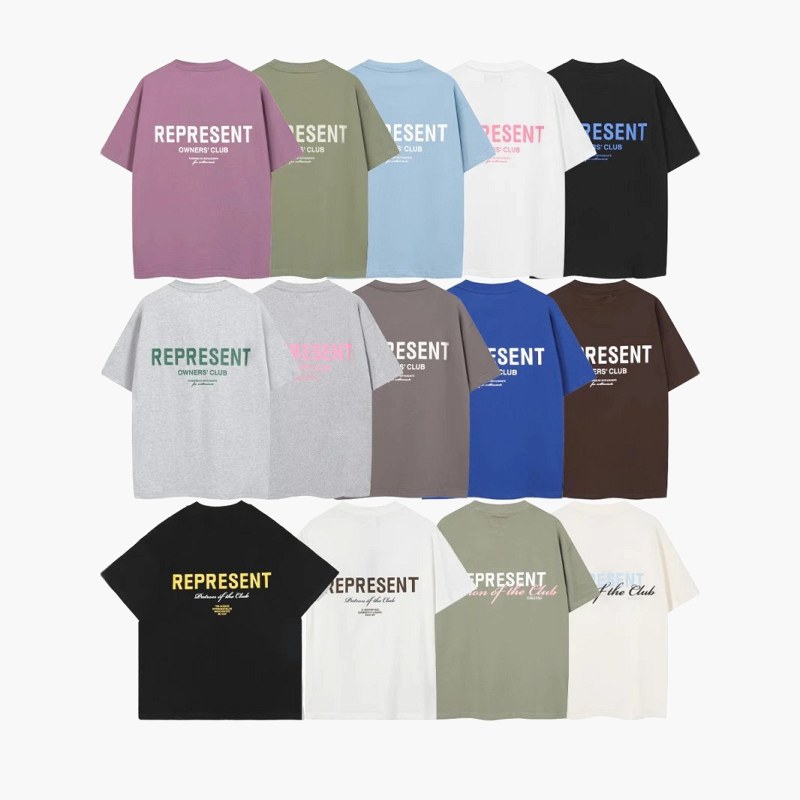
Represent's angel graphic tee has one spec that matters more to a parcel planner than to a shopper: the listing leaves the weight field blank. Everything else in the row is ordinary — combed cotton, a loose pullover crew neck, standard short sleeves, a 180–250 gsm weight band and 44-odd colourway names running from rep core black to Rep249 white — but a zero in the weight column means you cannot price a shipment until someone puts the shirt on a scale. So that is where we started.
What we ordered
We bought one tee through the agent at USD 7.76 against a crossed-out USD 9.26, SKU 7715699507, size L, in the plain black core colourway. Sizes run S–XL. The listing describes a relaxed, short-sleeve crew neck in combed cotton with a breathable finish. Stated weight band: 180–250 gsm. Stated weight for the parcel: nothing.
Our routine is fixed. Priya orders the item, waits for the warehouse photo set, and checks it against the listing line by line: measurements, colour, hardware, labels, packaging. If a photo is unclear she requests a re-shoot and logs the agent's turnaround. She then asks for a repack, weighs the box on our calibrated desk scale, compares the result with the agent's volumetric figure and records the gap to the nearest 10 grams.
The line-by-line ledger
Nothing in the check came back as a hard mismatch. The interesting rows are the soft ones, where the listing promises something a photograph cannot prove.
| Checked | Listing claim | What we found |
|---|---|---|
| Fabric | Combed cotton, breathable | Soft, dry hand; no scratch at the collar seam. Breathability is a spec claim, not something we can measure on a desk. |
| Weight | 180–250 gsm (a 70 g spread) | Our size L sample sat at 232 g on the scale, which places it mid-band on our fabric-area estimate — consistent, not exact. |
| Cut | Loose pullover, crew neck, standard short sleeve | Matched. Body is boxy through the waist, sleeve is a true short, neckline sits flat. |
| Finish | Non-iron treatment | Air-dried with a slight curl at the hem that pressed out. We cannot separate the finish from the cotton itself. |
| Colour | Core black | Within a step of the listing photo under our D65 lamp; no purple cast. |
| Wordmark plus small graphic elements | Placement matched the photo set; edges of the print are crisp out of the mailer. | |
| Labels | Brand wordmark, care instructions | Printed neck label and a care label present and legible. |
| Packaging | Not specified | Poly mailer with a handoff label. No box, no tissue. |
Where the parcel math actually went
A 232 g shirt folded into a 25 × 20 × 3 cm mailer is roughly 1,500 cm³, which is about 0.25 kg against a 6,000 divisor. That is the whole problem with ordering this tee on its own: the mailer bills at a volume the shirt does not fill, so a single-tee parcel costs you the packaging as much as the garment. Our repack confirmed the folded stack compressed by roughly a centimetre once taped, and the agent's volumetric figure came in a shade above our measured dimensions — the standard outcome when a photo is taken before the tape goes on.
Ask for a repack photo and a volumetric number before you consolidate. On a three-tee order the volume problem largely disappears; on a one-tee order it does not, and no amount of careful agent selection changes that.
Fit, print and the long game
The cut is genuinely roomy. Community reports on Represent tees mostly describe them as loose, with several buyers who take a medium elsewhere buying a small here — but at least one reviewer who sized down found the result tight. Our sample runs true to that split, so measure a tee you already own against the chart rather than trusting a single anecdote, ours included.
The print is the part we would set expectations around. Represent itself states that its cracked-print Angel graphics may lose ink over time, so a graphic that ages is the design intent, not a defect. Brand care guidance is to wash inside out at 30°C and skip the tumble dryer, which is what we would do with any printed cotton at this price.
Retail commentary on Represent graphic tees credits the brand with reliable graphics and seaming at its own price tier, and the seaming here is clean for a USD 7.76 garment. The gap between that shelf reputation and the agent price is the reason this listing gets ordered at all — but the money saved is best spent on consolidation, not on shipping a single shirt across the Pacific.
How we score it
Four and a fifth out of five. The garment matched its listing on every checkable row, the fabric weight landed inside its own band, and the price is unusually low for the construction. It loses ground on three honest points: the brand says the print will wear, sizing evidence is split, and the listing gives you no mass to plan with until an agent weighs it.
Why does the listing show no weight for this tee?
The weight field is blank on the source listing, so the 180–250 gsm band is all you get up front. Our size L sample weighed 232 g on the desk scale. Ask the agent for a scale photo and a volumetric figure before consolidating.
Is the non-iron finish worth trusting?
Partly. Our sample air-dried with a small hem curl that pressed out flat, but we cannot separate the claimed finish from the behaviour of the combed cotton itself. Treat it as a convenience, not a guarantee.
Should I ship one tee on its own?
No. A 232 g shirt in a 25 × 20 × 3 cm mailer bills closer to 0.25 kg on volume, so packaging, not fabric, drives the cost. Group it with other light garments and request a repack photo.