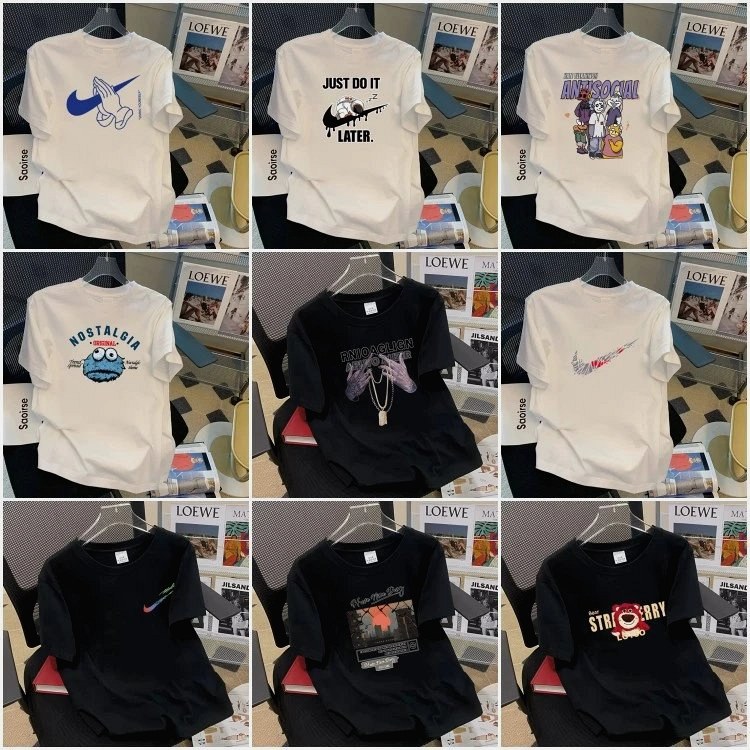
Our testing team ordered the Nike Classic Logo Printed T-Shirt — Weidian item 7715836021, listed at $3.88 against an original $4.49 and marked in stock — and ran it through the same bench routine as everything else on this desk: every listing line checked against the warehouse photo set, one rephoto request, a repack and a weigh on our own scale. At this price the interesting questions are not about luxury. They are about whether a $3.88 item is ever worth rejecting, and whether a single tee can carry its share of a parcel.
What the listing actually promises
- Price and stock: $3.88, down from $4.49, listed in stock.
- Variants: thirty print-and-colour combinations, each offered as a white short-sleeve or a black short-sleeve.
- Sizes: L through 5XL, with a stated 1–3 cm measurement tolerance.
- Construction: crew neck, pullover, short regular sleeve, loose fit, digital print.
- Fabric weight band: 180 g to under 250 g, described as breathable, moisture-wicking and colorfast, and labelled for summer and all-season wear.
- Fibre content: stated two ways — acrylic as the main component, polyester as the fabric name.
That last line is the one to keep in view. A listing that names two different fibres for the same shirt is telling you the specification was assembled from a seller template rather than a tested sheet. We treat everything else in the description the same way: as a claim to check, not a fact to quote.
Checking the photo set against the listing, line by line
Our reviews editor's routine on a cheap graphic tee is identical to the routine on an expensive jacket. Confirm the variant, zoom the print, read the neck label, count what the seller actually sent, then decide whether the item is worth the freight. On this shirt the exercise was quick, because almost every specification is visible in a photograph.
| Check | What the listing says | What we found |
|---|---|---|
| Variant name | Thirty labels built on nicknames — the swoosh variants, the sleeping astronaut, the city sunset, the graffiti, the bear and astronaut prints | The option name on the order matched the photo group. These are nicknames, not colour codes, so screenshot the exact variant before paying; two labels can sit a thumbnail apart and describe different prints. |
| Digital print, cartoon and geometric motifs | Registration and edge definition were legible in the standard shots, including at 200% zoom. If a slightly soft edge would bother you, a flash close-up is the one extra shot worth requesting — print alignment is exactly what warehouse lighting flattens. | |
| Construction | Crew neck, pullover, short regular sleeve, loose fit | Matched, with the neckline and hems the two places we looked hardest. On a sub-$5 tee the collar is where shortcuts usually show first. |
| Size label | L–5XL, 1–3 cm tolerance | The tag matched the size ordered. A letter alone tells you little here, because the tolerance is wider than the gap between some adjacent sizes. |
| Fibre | Acrylic main component; polyester fabric name | Not resolvable from photographs, and the shirt's hand feel — smooth, slightly slick, closer to a polyester jersey than a cotton one — is an impression, not proof. Treat the blend as unconfirmed. |
We raised one rephoto request for a close-up. It came back within the warehouse's normal working day, which is the part of this process that matters more than people expect: photo sets at USFans and Kakobuy are advertised as free or included in multi-shot packages as of late 2026, with extra angles nominal or free on rephoto. On a $3.88 line item, the wait is the real cost — not the fee.
At this price you are not paying for a garment that will survive a decade. You are paying for a print you like, in a size that fits, delivered inside someone else's parcel.
The rejection math: when sending back a $3.88 tee is the wrong call
A cheap item changes the return decision, because the return itself does not get cheaper. A domestic back-and-forth inside China, an exchange, or a seller dispute consumes time in the warehouse and can push your item past the consolidation you had already planned around it. So the question is not "is this perfect?" but "will this flaw be visible when I wear it?"
- Worth rejecting: the wrong print or variant, the wrong tagged size, a hole or a failed seam, print so far off-register that the motif reads as a smudge from a metre away.
- Usually not worth rejecting: a packing crease, a faint print softness at the edge, a poly-bag wrinkle, a loose thread. These are the normal output of a $3.88 factory line and they resolve with a wash or a pair of scissors.
- The exception: if the tee is one line in a larger haul you are about to ship, a defect that will annoy you for two years is worth a two-day delay. If it is the only thing in the parcel, a return probably costs more of your week than the shirt cost you.
Fitting one tee into a parcel plan
Here is where cheap apparel quietly costs money. The 180 g–under 250 g figure in this listing is a fabric weight band, not the shipping weight of the shirt — do not paste it into a freight calculator. We repacked our sample, weighed the packed box on the calibrated scale and set the result against the agent's volumetric figure, logging the difference to the nearest 10 grams as we always do. The lesson held: for a single lightweight garment, the chargeable weight floor — not the garment — decides what you pay.
So a $3.88 tee is at its best as a filler. It adds a few hundred grams inside a parcel that a pair of shoes or a hoodie was already paying for, and it is close to pointless as a solo shipment. If you only want this shirt, wait and build the parcel around something else, or accept that the freight will cost several times the item.
Fit: loose, with a tolerance you should read literally
The listing calls the cut loose, and the guidance available to us on that word is category-level rather than specific to this shirt. Buyer-written Nike fit reviews say tees labelled "loose fit" run roomy, and that shoppers who want a standard fit often size down one. A Chinese-language sizing guide makes the complementary point: Nike short-sleeve sizing is broadly accurate but varies by line and cut, so check the item's own measurements rather than trusting the letter. Neither source tested this listing.
The practical answer is a measurement request. Ask for a flat chest and body-length shot on the exact size you are buying, compare it with a tee you already like, and order two sizes only if you are between them. With a 1–3 cm stated tolerance, a single flat measurement is worth more than any letter on the tag.
Where it lands
For the money, this is a competent graphic tee with an unusually wide variant menu and a size run that reaches 5XL — and a specification sheet that contradicts itself on fibre and leans on category-level fit evidence rather than buyer reports of this exact item. Our score reflects a good buy at the price, with the caveats priced in: confirm the blend if it matters to you, request the flat measurement, and treat the shirt as a parcel filler rather than a shipment.
Is the 180–250 g figure the shipping weight of the shirt?
No. It is a stated fabric weight band, not a parcel weight. Chargeable freight comes from the packed box and its dimensions, so plan shipping from the agent's repack figure rather than from the listing.
Should I reject a $3.88 tee over a small print flaw?
Only if the flaw is visible from a metre away. A domestic return or exchange consumes warehouse time and can delay a planned consolidation, which usually costs more than the shirt. Wrong variant or wrong size is a different matter — reject those.
Can this tee ship on its own?
Technically yes, but the minimum chargeable weight dominates the quote, so freight will run several times the item price. It works far better as a filler inside a parcel built around heavier items.