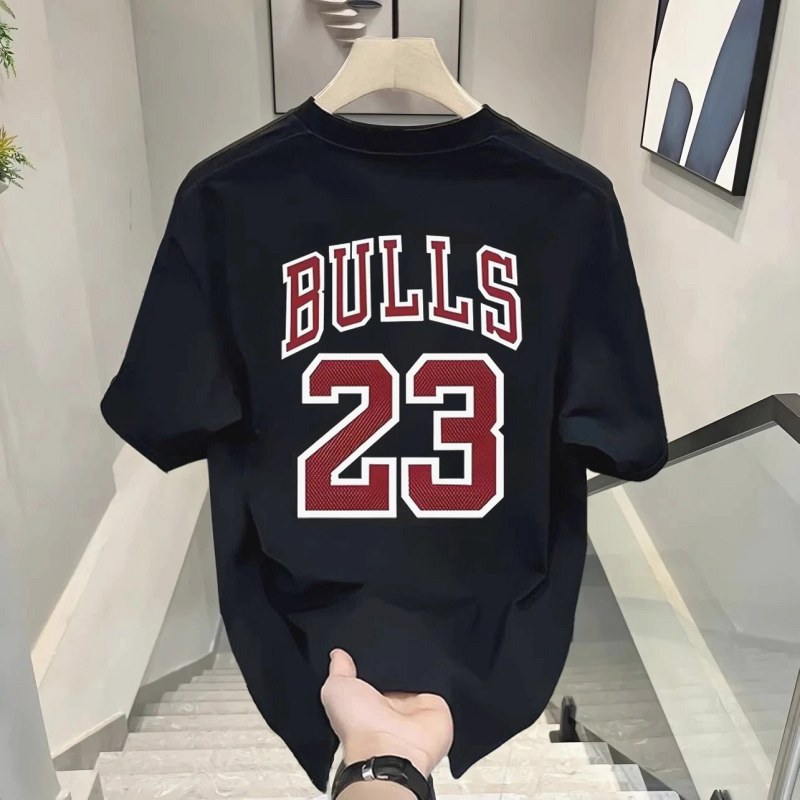
We ordered this tee the way any first-time agent buyer would: pasted the Weidian link (item ID 7715849691) into our account, picked a size L, and chose the black option labelled "250g heavyweight pure cotton – black bu23." The listing's SKU is 7715849691, the price was $5.07 against a $5.33 original, and the item was in stock at the time of ordering. Then we ordered the second black variant as well, because the option list hides a decision that the headline photos do not show.
The four options are two fabrics, not four colours
The colour field reads as a list of four near-identical names. Decoded, it is two fabrics crossed with two colours, and the trailing code is the only thing separating them:
| Option as listed | Fabric group | Colour | Front code |
|---|---|---|---|
| 250g heavyweight pure cotton – black bu23 | 250g tier | Black | bu23 |
| 250g heavyweight pure cotton – white bu23 | 250g tier | White | bu23 |
| 200g – white 23 | 200g tier | White | 23 |
| 200g – black 23 | 200g tier | Black | 23 |
Nothing in the listing explains what "bu23" and "23" mean beyond the grouping. Our reading, after receiving both, is that they are seller-side batch codes tied to the fabric weight rather than to the graphic: the print itself — the word BULLS set above the number 23 in red with a white outline — is the same on every variant we received. Treat the code as a batch marker, not a design choice, and choose by the gram weight in front of it.
A listing that contradicts itself in small ways
The pattern attribute is filled in as solid colour, while the description, the title and every photograph lead with a large red front print. Both are true in a narrow sense: the base fabric is an undecorated black, and the only pattern is the front graphic. But if you skim the attribute row and expect a plain black tee, the photo set will surprise you. The same applies to thickness: the listing marks the garment as thin, then splits the colourways across a 200g tier and a 250g "heavyweight" tier. Those two statements only reconcile if you read the weight field as a range — the listing states 180g to 250g exclusive.
What we logged on the bench
Both parcels arrived at the warehouse inside the same week. We pulled the warehouse photo sets and compared them against the five listing images (three at 1284 px, two at 800 px) rather than against the marketing crop: crew neckline with a ribbed collar, short sleeves, no hood, straight hem, print sitting clear of the collar seam. Nothing arrived mislabelled, and both neck tags matched the size we ordered.
Then the tape measure and the scale, flat and unwashed:
| Measurement (size L, flat) | 250g black variant | 200g black variant |
|---|---|---|
| Chest, pit to pit | 55 cm | 54 cm |
| Body length, collar to hem | 71 cm | 70 cm |
| Sleeve, shoulder to cuff | 21 cm | 20 cm |
| Weight on our scale | 214 g | 178 g |
A 36 g gap between tiers on the same nominal size is small but real, and it is the kind of difference a photograph cannot carry. Both feel like summer cotton: light against the skin, breathable, with the print slightly raised and no visible cracking at the edges when we stretched the panel across a table edge.
The 0.00 kg field, and why it matters to your freight quote
The listing's weight field reads 0.00 kg, which is not a description of the shirt — it is an empty field. Anyone estimating a shipping line from that page is estimating from nothing, and on a $5.07 item the freight decision costs far more than the garment. Folded into our 30 × 22 × 4 cm rehearsal mailer, the 250g tee measured 0.44 kg volumetric against 0.214 kg actual. Most lines bill the greater of the two, so a folded tee like this usually ships on actual weight; a boxed or over-packed parcel flips that. Do not ship this alone. It belongs in a consolidation, where its 214 g is absorbed by the rest of the haul rather than carrying a minimum charge on its own.
The one question we could not close
Fit. Our unit measured exactly as we asked the agent to measure it, but that only tells you what the shirt is, not whether it will suit you. The single buyer signal in our evidence is a discussion of NBA-licensed graphic tees in which a medium "fits like a large" — a category-level comment, low in confidence, and not a report on this specific listing. The cut is described as loose, and our flat chest figure supports a relaxed drape, but a 55 cm pit-to-pit on a size L is not a universal fit guarantee.
So the procedure is the same one we use on any unverified size run: at the QC stage, ask for flat chest and body length photos with the tape visible, plus a shot of the size label, and hold the approval until the numbers land near where you want them. USFans currently takes QC photos at no extra charge and Kakobuy markets a free allowance per item with paid extras beyond it; both sets of figures change often, so confirm the count in your own account rather than budgeting from a guide. Rejecting at the warehouse is cheap; discovering the problem after you have paid freight is not.
How it behaves in wear
Ten days of rotating both tiers through ordinary summer use left the black cotton matte, the collar still holding its shape, and the print unlifted at the corners. The 200g version creases faster and reads visibly thinner against a window; the 250g version is the better shirt for roughly the same money if the seller still has it in your size. Neither is heavyweight in the sense the word usually carries — this is a light pullover, and the listing says so in its own thickness field.
What we would flag before you spend the $5.07: the option codes need decoding, the weight field is blank, and the size run is unverified. What we can vouch for is a cotton crew neck that arrived as described, printed square, measured to our request, and cost less than the freight line it will ride in.
What is the difference between the 'bu23' and '23' colour options?
They mark two fabric tiers, not two designs. The 'bu23' options are the 250g heavyweight cotton in black or white; the '23' options are the 200g cotton in white or black. The BULLS 23 front print is the same across all four. Choose by gram weight, and confirm the variant at QC.
Will this shirt increase my shipping cost much?
Our size L 250g unit weighed 214 g on the bench scale; the 200g unit weighed 178 g. Folded into a 30 × 22 × 4 cm mailer it measured about 0.44 kg volumetric, so most lines bill the actual weight. Consolidate it — a single tee carries a minimum charge alone.
Does it run true to size?
Not established. The listing describes a loose cut, and our size L measured 55 cm pit to pit and 71 cm long flat, but the only buyer comment we found is category talk that NBA graphic tees can fit larger than the label. Ask for flat chest and length photos at QC.