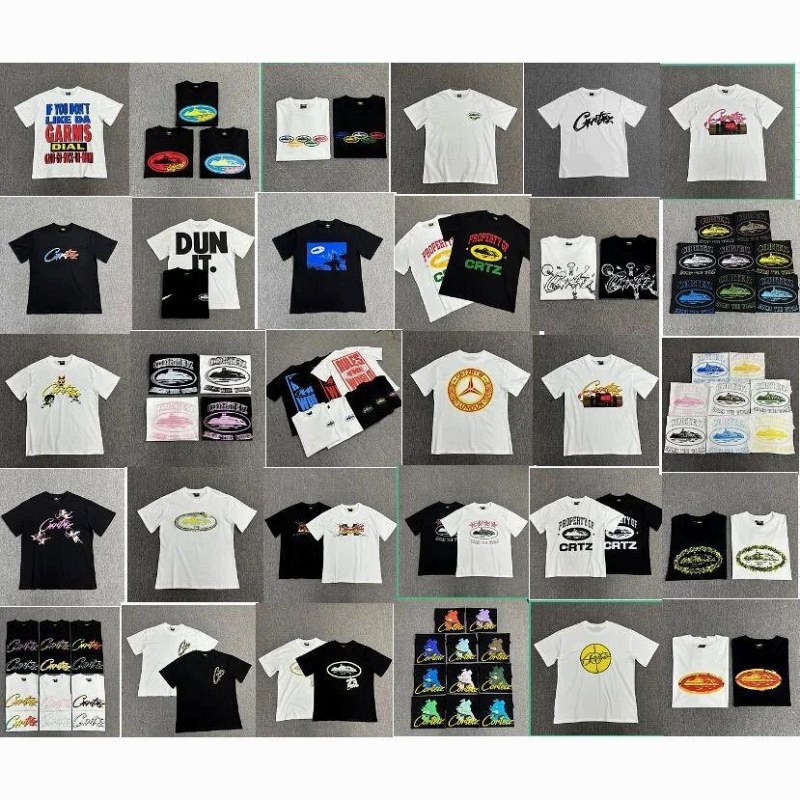
We bought the Corteiz graphic print multicolor T-shirt collection as a parcel-planning exercise before we treated it as a garment. At $4.93 USD (down from $5.91, listed as in stock, SKU 7718770988) it is one of the lightest paid line items you can drop into a consolidation, and light items are precisely where an agent's volumetric maths starts to cost more than the price tag. Three pieces came in — colour codes 3156 black, 3156 white and 3103 yellow-print — in sizes L, L and XL, and all three went through intake, QC review, a polybag strip, two repacks and two weighings on our bench scale before we handed any of them to a shipping line.
What arrived in the intake card
- Three short-sleeve, loose-fit crew-neck tees, each in its own printed retail polybag, no hangtags, no tissue, no desiccant.
- Fabrics matched the listing description: polyester, standard thickness, a dry hand-feel rather than a cotton-soft one, and a visible sheen on the black sample.
- The 3D-effect lettering sits proud of the fabric on all three; under our desk lamp at a low angle the print reads as a raised layer, not a flat screen.
- Chest and body length on all three sat inside the 2–4 cm tolerance the listing declares, checked against the chart on the product row.
- Sizes span S–3XL and the variant list is long — dozens of rows across black, white, yellow, red, green, pink, blue, orange and brown lettering and motif combinations — so the colour code, not the colour name, is the thing to quote to an agent.
The 0.00 kg row is a placeholder, not a shipping estimate
The catalog row for this tee carries a 0.00 kg weight field. Read literally that would make three tees weightless; on our scale the intake card for the three pieces came to 0.694 kg. Treat any zero or blank weight on a marketplace row as a missing field that an agent has to resolve during intake, and expect the QC stage to be where the real number appears. The same caution applies to the listing's 180–250 g figure, which describes fabric weight per square metre inside the size range, not the mass of a folded tee in a bag.
Our scale against the agents' volumetric figures
After the first weighing we requested a repack, then weighed again and compared the result with the volumetric figure each agent generated for the same folded garment. All weights below are for the single black L sample.
| Parcel state | Our scale | Volumetric figure | Gap |
|---|---|---|---|
| Tee in retail polybag, as received (30 × 22 × 5 cm card) | 238 g | 413 g (÷8000) | +175 g |
| Tee alone, polybag removed | 227 g | — | — |
| Repack, 32 × 23 × 5 cm mailer with tissue | 246 g | 460 g (÷8000) | +214 g |
| Repack, 26 × 20 × 4 cm mailer with tissue | 244 g | 260 g (÷8000) | +16 g |
| Tight repack quoted at ÷6000 divisor | 244 g | 347 g (÷6000) | +103 g |
The lesson is arithmetic, not brand: the tee weighs 227 g, but the box geometry an agent measures can triple the billable figure. Moving from a 32 × 23 × 5 cm mailer to a 26 × 20 × 4 cm mailer cut the volumetric figure from 460 g to 260 g — a 200 g saving on a $4.93 item, achieved purely by folding flatter and asking for a smaller outer. The same 2,080 cm³ box quoted against a ÷6000 divisor still bills at 347 g, so the divisor your chosen agent applies matters as much as your folding.
What the repack changed, and what it did not
Removing the retail polybags saved 11 g each and left the prints unprotected against the mailer's inner seam. We lined the tighter mailer with a single sheet of tissue, which added 4 g and kept the 3D lettering off the corrugate. Two of the three tees travelled without any polybag at all and arrived with no transfer marks; the yellow-print sample picked up a faint crease across one letter that relaxed after a cool wash. If you plan to hold tees in a warehouse for weeks before consolidation, leave the polybag on and accept the extra grams — the trade is protection against dust and handling scuffs, not shipping cost.
Print surface, seams and three cool washes
We washed all three at 30 °C, inside out, no dryer. The raised lettering stayed bonded at the edges and none of the three prints cracked or lifted; the yellow-print sample showed the most softening of the three. Neckline recovery was adequate rather than impressive: the crew rib sat flat after drying but had stretched roughly half a centimetre across the opening by the third wash. Stitching at the shoulder, sleeve and hem was even on all three, with no loose thread ends in the intake card.
"A $4.93 tee is cheap to buy and cheap to store, but it is not cheap to ship if you let an agent cube it out. Weigh it, fold it flat, and quote the mailer size in the same message as the colour code." — Priya Raghunathan
What we could not confirm
Buyer evidence for this exact listing is thin. The fit reports we found describe Corteiz tees generally — true to size, wide at the chest, slightly cropped, sleeves finishing past mid-upper-arm — and those reports support ordering your usual size rather than sizing down. Quality opinion on the brand is split: some buyers call the tees poor value for money, while long-term customer reviews of the brand's store sit around 4.6/5 across hundreds of ratings. Neither view was generated by this listing, and we are not treating our three-sample wash result as proof of durability. Anyone needing certainty on a specific colour code should ask the agent for a close-up of the print under directional light before the parcel is sealed.
As a planning row, the tee behaves well: predictable mass, cheap enough to use as parcel filler, and a variant list wide enough to build a small colour run. As a garment, it is a lightweight polyester print tee that will suit casual summer wear and will not pretend to be heavyweight cotton. Order the size you normally wear, quote the colour code rather than the colour name, and put the mailer dimensions in writing before you pay for a shipment.
Does this tee really weigh 0.00 kg as the listing row says?
No. That field is unfilled, not a shipping weight. On our bench scale the black L sample came to 227 g bare and 238 g in its retail polybag, and three tees arrived as a 0.694 kg intake card. Expect the agent to weigh it during intake.
How much does the tee add to a consolidated parcel?
Plan for roughly 227–246 g of actual weight. The billable figure depends on the outer box: our 32 × 23 × 5 cm mailer quoted at 460 g volumetric, while a 26 × 20 × 4 cm mailer came down to 260 g.
Should I order my usual size or size up?
Order your usual size. Buyer reports describe Corteiz tees as running true to size with a wide chest and slightly cropped body; size up only if you want the drape looser. Those reports are brand-wide, not specific to this listing.